Pages

Sunday, April 29, 2012

3.2 billion pixel Camera (Yes, Billion!)


A 3.2 billion-pixel digital camera designed by SLAC National Accelerator Laboratory is now one step closer to reality. The Large Synoptic Survey Telescope camera, which will capture the widest, fastest and deepest view of the night sky ever observed, has received “Critical Decision 1” approval by the U.S. Department of Energy (DOE) to move into the next stage of the project.

The Large Synoptic Survey Telescope (LSST) will survey the entire visible sky every week, creating an unprecedented public archive of data – about 6 million gigabytes per year, the equivalent of shooting roughly 800,000 images with a regular eight-megapixel digital camera every night, but of much higher quality and scientific value. Its deep and frequent cosmic vistas will help answer critical questions about the nature of dark energy and dark ...
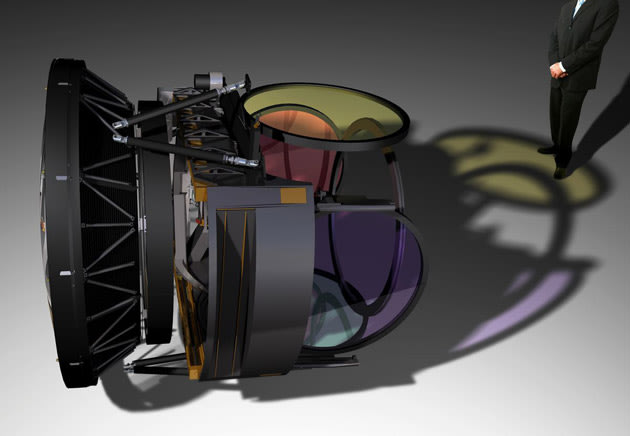

“With 189 sensors and over 3 tons of components that have to be packed into an extremely tight space, you can imagine this is a very complex instrument,” said Nadine Kurita, the project manager for the LSST camera at SLAC. “But given the enormous challenges required to provide such a comprehensive view of the universe, it’s been an incredible opportunity to design something so unique.”


Now that the LSST camera has passed Critical Decision 1, the project begins a detailed engineering design, schedule, and budget phase. While the DOE funds the design and construction of the camera, the full cost and logistics of the new telescope are being shared by the DOE and the National Science Foundation, as well as a large partnership of public and private organizations in the United States and abroad.

“This is the culmination of years of work by a large group of dedicated people,” said SLAC’s Steven Kahn, LSST deputy project director and leader of the DOE-funded effort on LSST. “I’ve personally been working on this since 2003, and it is tremendously satisfying to finally see this move forward to the point when we can begin to carry out the project.” If all continues as planned, construction on the telescope will begin in 2014. Preliminary work...As the primary component of all energy in the universe, the still-mysterious dark energy is perhaps the most important research target for LSST and the physicists who are building it. Yet that’s only a start. LSST’s fire hose of publicly available data will allow astronomers the world over to view faint and rapidly changing objects, create 3D maps and time lapses of the night sky and detail Pluto’s celestial neighborhood, the Kuiper belt."Not only should LSST revolutionize our understanding of the universe, its contents and the laws that govern its behavior, but it will also transform the way all of us, from kindergarteners to professional astrophysicists, use telescopes,” said Tony Tyson, LSST director and a professor of physics at the University of California, Davis. “These are exciting times!".

 LSST and Calypso



Two renderings combine to create this image of the LSST summit facility and Calypso, the small adjacent atmospheric telescope. March 2011
(Image credit: LSST Corporation)

A combination of two renderings, showing the telescope on the summit. March 2011 (Image credit: LSST Corporation)



In this artist's rendition, the LSST primary mirror is seen through the slit of the dome at sunset. The LSST will carry out a deep, ten-year imaging survey in six broad optical bands over the main survey area of 18,000 square degrees. 2011 (Image credit: Todd Mason, Mason Productions Inc. / LSST Corporation)A simulated night sky provides a background for the LSST facilities building on Cerro Pachón. The LSST will carry out a deep, ten-year imaging survey in six broad optical bands over the main survey area of 18,000 square degrees. 2011 (Image credit: Todd Mason, Mason Productions Inc. / LSST Corporation)


LSST Facility exterior at night.


A colorful night sky provides a background for the LSST facilities building on Cerro Pachón. The LSST will carry out a deep, ten-year imaging survey in six broad optical bands over the main survey area of 18,000 square degrees. 2011 (Image credit: Todd Mason, Mason Productions Inc. / LSST Corporation)


LSST Optical Elements at sunset.



The optical elements of the LSST appear suspended over the coplanar primary/tertiary mirror. The secondary mirror, camera lenses and filters are also visible. 2011
(Image credit: Todd Mason, Mason Productions Inc. / LSST Corporation)


LSST telescope


The 8.4-meter LSST will use a special three-mirror design, creating an exceptionally wide field of view and will have the ability to survey the entire sky in only three nights.
(Image credit: LSST Corporation)


LSST telescope in the dome



A cut-away view showing a rendering of the LSST in the dome, current as of January 2009


Tuesday, April 24, 2012

7 ways to beat your worries

Can’t stop worrying? Try out our seven ways to beat the bother and boost your happiness. Whilst worrying is necessary for spurring us on to achieve our goals, chronic worrying can disrupt the balance in our nervous system and be detrimental to our health. Here are seven ways to wash away your worries:

How to stop worrying, tip 1: Forget the things you can’t change
If you’re worrying about something that’s happened in the past, you need to stop. The power of your mind isn’t strong enough to solve problems through panic, so it’s important to beat your worries by thinking logically and tackling them head-on. Bad memories from the past are toxic to our health and highly counterproductive so you must bury the burdens of your past and move on.

How to stop worrying, tip 2: Write a worry list

Write down everything you’re worried about; the bills, your job, the car MOT – everything. Then rate them on a scale of one to 10, with 10 being the things that are concerning you most. You can then turn your worry list into an action list. Take action on the worries that you rated the highest first, and then work through the rest of the list. You will feel a sense of relief each time you tick a worry off, and this is a sure-fire way to boost your happiness and relieve your worries.

How to stop worrying, tip 3: Discipline your thoughts
If you’re a chronic worrier, you need to learn to take control of your thoughts rather than letting them take control of you. To do this, every time you think a negative thought, you must turn it into a positive. Every time you worry, think “is this really helpful?” If the answer is no, turn the thought into a positive or forget it completely. Whilst this may seem difficult at first, it will eventually become second nature and you will find that turning a negative into a positive is a much more constructive way of dealing with your thoughts.

How to stop worrying, tip 4: Distract yourself through relaxation

When we’re worried – particularly about a number of things at once – our brains don’t tend to find a logical solution to our problems. In order to think logically, we must take the time to relax and unwind. Breathe in through your nose, and out through your mouth. After a couple of minutes of relaxation, the tension will leave your body and you will be in a better position to tackle the problem from a fresh perspective.Woman relaxing in bath with candles

How to stop worrying, tip 5: Talk to friends and family

A problem shared is a problem halved. Talk to your family, your friends, or a doctor if you have a good relationship with them. Sometimes saying your problems out loud can get your thoughts straight in your head and if you’re worrying about something useless, saying it out loud can make you realise that it’s just not worth the worry. With those close to you, you can laugh, cry, and moan as much as you like without being judged and this is a healthy way to relieve stress.

How to stop worrying, tip 6: Confront the problem head-on

Some worries can’t be tamed through talking to others or relaxation. A problem that won’t go away until you physically do something about it needs to be confronted head-on. Sometimes, we have so much on our mind that we don’t know what to deal with first. Make a decision on which problem you want to solve and how you will go about it, and then stick to it. You will probably find that once you resolve the problem, you’ll wish you’d done something about it sooner.

How to stop worrying tip 7: Put things into perspective

Don’t be overwhelmed by small things; try and see the bigger picture. Is your problem really as bad as you’re making it out to be? The chances are there will be many people worse off than you. Instead of zoning in on certain things and panicking about them, put everything into perspective. Does this problem affect your entire life? Will you still be panicking about this in a few weeks or months time? If the answer is no, then it’s really not worth the worry.

Saturday, December 24, 2011

Aakash tablet's delivery pushed to next year

DataWind, the Canadian company that is manufacturing Aakash, will start distribution of the much anticipated low cost Android tablet from next month for which online booking had started on December 15.

A spokesperson of Datawind said to The Mobile Indian, "People who have booked the Aakash tablet online will get its delivery in January.” The spokesperson, however, didn't cite any reason for the delay. Earlier the company had said that the Rs 2,500 Aakash tablet will be delivered within seven days of online booking.

Flip Flops

On earlier occasions also, Datawind have failed to honour their commitment as the tablet was supposed to be made available in retail stores by the end of November. Now it is expected to hit the stores only in February.

DataWind initially said that the Aakash tablet will be available to students only through colleges and schools. However, later it started online booking of Aakash for everyone including students. Besides,DataWind have given only 10,000 Aakash tablets to the government for distribution in schools and colleges of the initial 1 lakh proposed.

The Mobile Indian got more than 200 emails and 300 calls from users who complained that after booking the tablet online they didn't get any call or confirmatory email.

Even after The Mobile Indian's repeated request for clarification on the hardship faced by the consumers, Datwind didn't share any information instead it said: "An official statement will soon be released and we will keep you posted.”

We hope this time Akash Tablet is delivered to consumers on time.

About Aakash and UbiSlate

There are two versions of the tablet. The original Aakash tablet comes with much lower specifications and is priced at Rs 2,500. Its cousin — named as UbiSlate, is comparatively powerful and is priced at Rs 2,999.

UbiSlate will be powered by Android 2.3 and will have a resistive touchscreen, Cortex A8-700 MHz processor and graphics accelerator HD video processor, 256 MB of RAM and 2 GB of internal memory. Other specifications are - one standard USB port, 3.5 mm audio jack, a 7 inch display with 800 x 480 pixel resolution, resistive touchscreen, GPRS and WiFi support.

On the other hand, the 7 inch screen bearing Aakash tablet has Android 2.2 operating system, Arm11 — 366 Mhz processor, 2100 battery, WiFi and will have support for 3G modem. The price difference between the Aakash and UbiSlate is because the commercially available product will include a cellular modem, allowing it to deliver web access anywhere there is a cellular connectivity, and also to function as a mobile phone. Notably, Internet access on both the tablets across mobile networks will be priced at Rs 99 for 2GB.

Sunday, August 21, 2011

'A Few Good Men' of Team Anna

“A Few Good Men” of Team Anna
Anna Hazare is a 74-year-old gentleman but his enthusiasm, zeal and energy can put the youth in their 20s to shame. His crusade against corruption has brought out the entire country [except the "cyskics" (cynics, skeptics and critics all rolled into one)] on the streets. While Anna Hazare remains the man of the moment, there's an entire dedicated team which works with him and whose members' full-time profession is activism. Then there are also dedicated people who remain behind the scenes and take care of the social media campaigning, technical stuff, logistics etc.
Let's take a look at the front-bench members of the Jan Lokpal movement:

“A Few Good Men” of Team Anna

Arvind Kejriwal

Recipient of the prestigious awarded Ramon Magsaysay Award for Emergent Leadership in 2006, Kejriwal has emerged as a true “youth icon” during the last few months. He was born in Hissar, Haryana in 1968, and graduated from IIT Kharagpur as a Mechanical engineer in 1989. Arvind Kejriwal was always concerned about corruption and the passivity of the people. After quitting his job with the Tata Steel, he took time off to work with the Missionaries of Charity and the Ramakrishna Mission in eastern and northeastern India. He was also instrumental in spreading awareness about the passing of the Right to Information (RTI) act.
In the ongoing movement for Jan Lokpal, Arvind is considered a key figure along with Anna Hazare. People who work with him sings songs in the praise of his intelligence, which, they say, is “razor-sharp”.
Awards and Honours:
2004: Ashoka Fellow, Civic Engagement.
2005: 'Satyendra Dubey Memorial Award', IIT Kanpur for his campaign for bringing transparency in Government.
2006: Ramon Magsaysay Award for Emergent Leadership.
2006: CNN-IBN, 'Indian of the Year' in Public Service.
2009: Distinguished Alumnus Award, IIT Kharagpur for Emergent Leadership.
2010: Policy Change Agent of the Year, Economic Times Corporate Excellence Award along with Aruna Roy.

“A Few Good Men” of Team Anna

Kiran Bedi

First Indian IPS officer, Kiran Bedi has always been known as a woman of substance and will power. A close associate of Anna, she has played an active role in the entire Jan Lokpal movement. She began her career as a Lecturer in Political Science (1970-72) at Khalsa College for Women, Amritsar. In July 1972, she joined the Indian Police Service. While in the police, she carried out several reforms. She also served as Director General of India's Bureau of Police Research and Development.
In 2007, she took voluntary retirement to undertake newer tasks in life. After retirement, Kiran Bedi launched a new website, www.saferindia.com which aimed at helping people whose complaints were not accepted by the local police. This project is undertaken by the non-profit, voluntary and non-government organization she founded, the India Vision Foundation. Kiran is a Ph.D. in Social Sciences from the Department of Social Sciences, Indian Institute of Technology, New Delhi.
Awards and Honours:

“A Few Good Men” of Team Anna

“A Few Good Men” of Team Anna

Prashant Bhushan

Based in Noida, Prashant Bhushan (born 1956) is an Indian lawyer and social activist. He is the son of eminent lawyer Shanti Bhushan. In his career spanning 15 years he has worked on around 500 PILs (Public interest Litigation). He has been a rigorous campaigner of judicial reforms. He is a member of the committee constituted in April 2011 for the Jan Lokpal bill. He is said to be a man of steel who doesn't thinks twice before exposing the wrongdoings in the courts.
Bhushan was the member of the committee which drafted the Jan Lokpal Bill. He has been sharply critical of the government's version of the Lokpal calling it “ineffective” and “useless”.

Shanti Bhushan


“A Few Good Men” of Team Anna
Not many would know that the Lokpal Bill was the brainchild of Shanti Bhushan who conceived it while being the law minister in the Morarji Desai government in 1977. Bhushan was an active member of the Congress (O) party (different from the Indian National Congress) and later the Janata Party. He was a member of the Rajya Sabha from 14 July 1977 to 2 April 1980 and the Union Law minister in the Morarji Desai ministry from 1977 to 1979. He joined the Bhartiya Janata Party in 1980. In 1986, he resigned from BJP after the party acted against his advice over an election petition.
Along with his son, he has been actively involved in bringing judicial reforms. He fought (for his client) many legal cases against Indira Gandhi. Shanti Bhushan is the co-chairman of the of the joint committee constituted in April 2011 for the Jan Lokpal Bill.

Swami Agnivesh


“A Few Good Men” of Team Anna
Agnivesh is an Indian politician, self-titled Arya Samaj scholar, and social activist. He is best known for his work against bonded labour through the Bonded Labour Liberation Front, which he founded in 1981.In the late 60s, he joined the Arya Samaj and took “Sanyas” vows. In 2005, Agnivesh was part of a two week campaign against female foeticide that travelled across India. Agnivesh also argued at a conference on economic development and religion sponsored by the World Bank that people should be allowed full freedom of movement across borders through the elimination of all passports and immigration laws.
Swami Agnivesh has been closely associated with the Jan Lokpal movement and is often seen campaigning strongly for it.

Saturday, August 20, 2011

10 most corrupt Indian politicians


10 Most Corrupt Indian Politicians
While everyone has been animatedly supporting Anna Hazare's fight against corruption, people seem to have forgotten who the people are who actually led to this situation.
The peak of irony was when Anna was, allegedly, lodged in the same jail that housed the people who were responsible for two of the biggest scams in the country ever. How must the authorities have felt when they saw Raja and Kalmadi fill their plates while Anna was on a fast because of their misdeeds?
Corruption has become an unavoidable part of politics and every now and then, one or the other politician re-affirms this fact.
Here is our pick of the 10 most corrupt politicians of India.

Suresh Kalmadi


10 Most Corrupt Indian Politicians
Suresh Kalmadi, almost single handedly caused a loss of hundreds of crores of rupees to the country. The Commonwealth Games, organized by Kalmadi was no less than a loot with numerous reports of the magnum opus event being soaked in corruption making headlines way before the Games had even started. Apparently, out of Rs. 70000 crores spent on the Games, only half of the amount was actually spent. Owing to his involvement in the scam, Kalmadi was charged with corruption and sent to Tihar jail.

A. Raja


10 Most Corrupt Indian Politicians
A scam worth Rs. 176,000 crore had former Union Cabinet Minister for Communications and Information Technology, Andimuthu Raja at the centre. A. Raja as he is generally called, was the prime accused in the 2G spectrum scam, which was the largest that the country had seen in a long time. Following the shocking exposure, Raja was indicted and forced to resign. Presently, he is too has been lodged at the Tihar jail and is awaiting his trial.

Mayawati


10 Most Corrupt Indian Politicians
Mayawati has always been criticized for ostentatious display of power in her state. She has allegedly used her status as chief minister to amass large amounts of personal wealth. She was charged with corruption when the Taj Heritage Corridor Case was uncovered. Mayawati's birthdays have always been media events, where she usually appears decked in diamond jewellery and also accepts public donations for which, she often comes under fire. Her assets are worth millions of dollars and in the year 2007-08, she had paid an income tax of Rs. 26 crores, which placed her amongst the top 20 taxpayers of the year.

Lalu Prasad Yadav


10 Most Corrupt Indian Politicians
The fact that Lalu Prasad Yadav has been an accused in 63-odd cases serves for the fact that Lalu stands as one of the strongest competitor in the list. The biggest scam that rocked Lalu's political career was the fodder scam which involved the embezzlement of Rs. 950 crore approximately. The accusation of nepotism against him has come up time and again but hardly any action has been taken against him owing to his 'connections' in the government.

Madhu Koda


10 Most Corrupt Indian Politicians
Former Jharkand Chief Minister, and only the third independent legislator to assume the office of chief minister in India, Madhu Koda was responsible for a scam worth over Rs. 4000 crore. The man exploited the state's natural resources by licensing illegal mining leases and stashing away the wealth amassed during the undertaking. Furthermore, the Maoists received a 30% share of the booty. Koda was arrested on charges of money laundering and is still in prison following the rejection of numerous bail applications.

Mulayam Singh Yadav


10 Most Corrupt Indian Politicians
Mulayam Singh Yadav is also known as one of the most corrupt ministers in the country despite not being directly involved in any major scams. Apart from his name being involved in appointments of tainted officers and mishandling of his power as chief minister, Mulayam Singh had one major allegation levelled against him– accumulation of disproportionate assets. The case drew limelight on his sons and daughter-in-law as they too were holders of the assests that amounted to crores of rupees.

Karunanidhi


10 Most Corrupt Indian Politicians
The corruptions charges against M. Karunanidhi are so many that he is often referred to as the king or emperor of corruption. He was accused of lending support to the LTTE and was indicted for abetting the LTTE in the interim report which oversaw the investigation into Rajiv Gandhi's assassination.
Karunanidhi reportedly institutionalized corruption in the South. He was a leading player in the cash for votes scams that are common in the southern region, as well as notorious foe extreme nepotism shown under his rule. Not so surprising, is the fact that the main accused in the 2G scam, A, Raja, considers him to be his mentor.

Sharad Pawar


10 Most Corrupt Indian Politicians
Very few people can miss the cosy relationship that Sharad Pawar shares with power and money.Every now and then, Pawar draws flak for alleged investments made by him and his family in various illegal projects. He was named by Abdul Karim Telgi, during a narcoanalysis test, stating that it was Pawar's brainchild to print fake stamp papers across the country and mint money. He was also accused in a multi-crore scam involving wheat imports and institutions headed by him and his close associates were served notices by the Bombay High Court for showing favoritism to his family.

Jayalalithaa


10 Most Corrupt Indian Politicians
The Chief Minister of Tamil Nadu has a staggering 46 corruption cases against her. Amongst the various scams were the Rs. 70 million coal import scam, Tansi land deal case, case of disproportionate assets and colour TV case, amongst many others. A raid in her residence and business establishments led to the seizure of some 28 kg of jewellery (worth Rs 51 crore), 91 wrist-watches, 41 air-conditioners, 10,500 sarees, 750 pairs of footwears, etc. She along with her former cabinet colleagues and senior bureaucrats who worked with her are still facing investigation with regard to corruption.

BS Yeddyurappa


10 Most Corrupt Indian Politicians
The most recent politician http://www.mensxp.com/special-features/top-10/5458-meet-the-top-10-young-politicians-of-india.html to be caught in the web of corruption is former Chief Minister of Karnataka, B. S. Yeddyurappa. While he has a number of corruption lying against him, the one that toppled his career was his alleged involvement in the illegal iron ore export scam in districts of Karnataka. A lot of blame game followed and ended up with Yeddyurappa losing his ministerial post last month. Despite his denial, his image as one of the most corrupt politicians of the country will not fade anytime soon.

Thursday, August 18, 2011

India must generate 5.5 crore jobs


Employment onus on India


Mumbai, Aug. 16: India will need to generate at least 5.5 crore additional jobs by 2015 if it wants to maintain the current ratio of employed people to total population, a study done by Crisil Research said today.
The study, Employment in India ' Uneven and Weak, said this number of 5.5 crore would be twice the number of jobs created during 2005-10 and that creating these jobs would pose a challenge without adequate policy support. While the current ratio of employed people to the total population stands at 39 per cent, the number of 5.5 crore also comes after accounting for many people employed today either retiring or losing their jobs.
According to the study, despite higher economic growth in the second half of 2000s, the country has been unable to generate sufficient number of jobs in manufacturing and services. For instance, the GDP growth increased to 8.6 per cent during 2005-10 from 6 per cent during 2000-05, but the net addition to jobs remained almost flat at around 2.7 crore during these two periods.
"While net additions to jobs during the second half of the 2000 decade have been higher than the much-discussed two million number, this is clearly not enough to ensure inclusive growth," it said.
Crisil said if the country wanted a solution in this regard, it should look at other countries, including China. The study noted large scale labour-intensive manufacturing units are a rarity in India, since the real cost of employing labour is high.
Moreover, it is also virtually impossible for a manufacturing company with more than 100 employees to fire any employee even if it is facing bankruptcy. Therefore, demand for labour has not increased fast enough in manufacturing.
However, in the service sector, particularly in high-skilled services such as financial intermediation and business services, there is a shortage of skilled labour that is constraining job creation.

Wednesday, August 17, 2011

Now, place your vote with a simple SMS

Voting by SMS?

Voting via SMS? Seriously, what an Idea, Sirji!
The bold attempt to making voting information as easy as SMS is shaping up for the coming February 2012 Brihanmumbai Municipal Corporation (BMC) civic elections.
It's not voting by SMS, but SMS is making SMS easier.
Voters will be able to get information about electoral roll, polling station and other details on voting cellphones, as part of a program that answers these, and similar queries.
The service will create a hassle-free voting process, and is part of the BMC's drive to promote voter awareness and overall turnout. To use this service, an SMS sent to 56677 will be responded with electoral roll number, polling booth and other information.


“Initially they have to SMS BMC (space) voters to 56677, then follow given instructions given,” said an official from BMC’s election department.
“Many times voters do not even know their electoral roll number, polling booth etc so they avoid voting,” “The service has not yet begun, but should be functioning in the next two months,” said Aseem Gupta, additional municipal commissioner.
India's emerging telecom market - the fastest in the world - should encourage such an initiative.
“Any mechanism used for electoral voting should ensure equal access for all,” says analyst Pratap Bhanu Mehta.
And, as the global media reminded us last year, Indians have more cellphones than toilets. Statistically, we have 851.70 million mobile phone subscribers (June 2011) and the second largest telecommunication network in the world after China.
In another 2 years, India will have 1.159 billion mobile subscribers by 2013.
If we can use phones for banking, as a substitute for a phone book, and even request blood from mobile blood banks, setting up unique voter identities shouldn't be an impossible task.


Tuesday, August 16, 2011

Analysis: How US debt crisis hits India


Why S&P downgraded the US, and what it means for India

Standard & Poor's, the credit rating agency downgraded the long term debt of the United States in a rating action on Friday, last week, setting off a week of political jawboning and intense volatility across global equity, debt and commodity markets.
So, what exactly were the concerns of the analysts and S&P that led them to issue the downgrade and why did the markets react by actually buying US debt and selling equities across other markets?
The answer requires us to delve into the turbulent waters at the intersection of global finance, geopolitics and the domestic political compulsions of American political parties.
What is a rating action and why is it so important?
Standard & Poor's is a credit rating agency. They rate the debt of various corporate and sovereign entities.  Usually, the issuer of the debt, pays S&P to rate the quality of the debt. Institutional investors across the world — mutual funds, pension funds, sovereign wealth funds, and hedge funds typically use these ratings, to make decisions on investing in the issuer's debt.  Most institutional investors require the issuer of debt to get a rating from one of the big 3 rating firms: Standard & Poor's, Moody's and Fitch ratings in order for them to invest. Many funds have investment philosophies that specify a minimum rating that a debt issue must have in order for the fund to invest in it.  Hence the market as whole usually uses the rating in making investment decision about the credit quality of the issuer. Although, the ratings are for debt -- since they take into account the future income stream of the issuing entity -- investors often use the debt rating of the issuer in valuing the equity of the issuer. In the case of the United States government, its AAA rating was a proxy for the prodigious $14 trillion GDP of the US economy as a whole!
The table below shows historical default rates for various grades of S&P municipal and corporate securities.
Cumulative Historic Default Rates (Historical up 2007)
Rating categories Moody's
S&P

Municipal Corporate Municipal Corporate
Aaa/AAA 0 0.52 0 0.6
Aa/AA 0.06 0.52 0 1.5
A/A 0.03 1.29 0.23 2.91
Baa/BBB 0.13 4.64 0.32 10.29
Ba/BB 2.65 19.12 1.74 29.93
B/B 11.86 43.34 8.48 53.72
Caa-C/CCC-C 16.58 69.18 44.81 69.19
Investment Grade 0.07 2.09 0.2 4.14
Non-Invest Grade 4.29 31.37 7.37 42.35
All 0.1 9.7 0.29 12.98
Source: Wikipedia


As you can see the default rates for AAA rated entities is very low. Also, in practical terms the default rates of AAA and AA+ rated securities don't differ much (both are less than 2%).  So, although the S&P downgraded the US, in practical terms it really doesn't mean much in terms of its repayment capacity.
An additional twist that US external debt has, is that, unlike India's external debt, it is denominated in US dollars; the currency that the US government controls. That is, they can payback the debt by simply printing dollars.  In other words, they can inflate the debt away.  Although this form of payment would not technically constitute a default, it is in effect an underpayment to the US government's creditors.
S&P's concerns on the political will to reduce deficits
So, in reality, nobody really doubts the ability of the US to service the debt.  S&P's concerns stemmed from the way in which the debt was being financed — through deficits, and the concern that the two main political parties in the US don't seem to be agreeing on how to control the deficits.
US GDP and government spending
Source: Wikipedia
US debt as a percentage of GDP
Source: Wikipedia
US Deficits and monetary policy, and political gridlock
So, how did the US deficits get so high and why is traditional monetary policy not working and what exactly are US politicians bickering about?
The origins of today's crisis are, of course in the sub-prime housing market in the US, whose problems, snowballed into the financial crisis of 2008, when credit markets essentially ceased functioning. In response the US Federal Reserve, the primary implementer of monetary policy in the US, lowered short-term interest rates until they were close to zero. At this point, interest rates no long have an effect and the Fed had to resort to a series of unconventional policy actions, with such esoteric acronyms as TALF, QE1 and QE2. These policy measures were intended to   inject liquidity into the market and induce commercial banks to start lending again, and kickstart the US economy. (See graphic.)
Unfortunately for the Fed, much of the money, which was in the form of bailouts for the banks wasn't used for lending, but was used up by banks to shore up their severely damaged balance sheets (in other words they simply invested the Feds money back in treasuries.)  To offset the lower interest rates, and the sloshing liquidity in developed markets, many banks and investors channeled money into emerging markets such as China, India and Brazil, igniting inflation in these economies that were ill suited to absorb such massive capital inflows. They also hurt developing economies by driving up commodity prices, such as those of oil and gold, further exacerbating inflation in these economies.
To make matters worse, the US government didn't fully disburse the money allocated for economic recovery, for the simple reason that government agencies were overwhelmed.  Both, Paul Krugman in his blog - The Conscience of a Liberal and Joseph Stiglitz in his interview, give a cogent summary of the events.
The solution to the problem, many Keynesian economists and their Democratic backers in the US Congress and the Obama administration argue, is to go through with the spending program and actually spend the money allocated for recovery and indeed expand spending programs and support for unemployed to stimulate economic recovery.
Republican opponents of the current administration, and neo-classical economists, argue that the solution is not more government spending, which would have effect of crowding out private investment driving the economy into further recession.  They argue, that spending should be cut (their first targets being social programs they dislike), and taxes should be reduced to provide an incentive for private enterprise. The strident tea-party wing of the Republican Party is particularly strident in its advocacy of this position.
That then, is the basis for the political gridlock that enveloped Washington, and eventually manifested itself in Congress' refusal to increase the debt ceiling, and finally S&P's rating action.
What this means for India
As the wildly seesawing markets demonstrated this week, the implications for India and emerging economies are not entirely clear.
On the face of it, one would imagine that US debt downgrade and what it says about the US economy, would imply that India by contrast, with its 8% plus GDP growth rate would become a more attractive destination for global liquidity.
The ironic, short-term effect, though, of the US debt downgrade, was to actually make US treasuries more expensive!   The reason is that a US debt downgrade implies a lowered ability for US to be borrower and purchaser of last resort that it had become during latter half of the 20th century. It in turn meant the developing economies -- especially Asian economies such as China, Japan and Korea -- that depended on exports to the US would be disproportionately hurt. In India, it meant that our bellwether IT companies would find it harder to grow their businesses in the US and the debt-crisis ridden Euro-zone.  This was the driver of the brutal sell-off on the Indian bourses on Monday.
In the medium term though, the effects are not very clear.  On the one hand, a slowdown in the global economy helps lower oil prices, which helps India. But on the other hand, FII and perhaps even FDI inflows into India might further exacerbate the already bad inflation situation, hurting the common man and driving down stock market valuations.  The direction of the market in the medium term may then depend on how investors view the relative strengths of such macroeconomic counter-currents.
There seems to be a greater consensus, amongst economists on the long-term direction of the world economy. The emerging markets of Asia and BRIC countries, India included are going to have an increasingly greater share of global trade, driven by young dynamic populations that are slowly becoming wealthier.  The US like its ideological predecessor, the British Empire, will no longer be the world's essential economy.  So, if you are in the markets for the really long term, and you have the stomach for the violent eddies in the flow of global finance, your grandchildren may yet thank you for your investments.


Wednesday, June 1, 2011

Maruti 800 reincarnated in China


Maruti’s decision to bring the curtains down on the iconic 800 left a lot of Maruti 800 fans emotional, and some even watery-eyed. They wished for the resurrection of the marque as a new classic. Now, the car that transfigured the way India moved has reincarnated, but in China. According to China Car Times, Jiangnan Auto has officially launched the mk2 Suzuki Alto (called so in China) at 17800rmb (Rs. 124000) making it the cheapest car in China today.
The Alto was put into production by four different companies - Chang’an Auto, Jiang Nan, Xi’an Tai and Sichuan Auto - in the Chinese market in the late 90s and early 2000s. Eventually, each of them had to stop production due to losses.
The car, just like its Indian ancestor, is powered by the 800cc engine which produces 36bhp, enough to get you around town.  After all, China has now an answer to the world’s cheapest car, our own Tata Nano.

Thursday, January 27, 2011

Golden Rules to Keep the Romance Alive


Getting into a relationship is easy, but keeping it alive is the difficult part. There are plenty of things, big or small, that can wreck an otherwise great relationship. Now, Dr Barton Goldsmith, a California-based psychotherapist reveals what all can kill romantic relationships and how to save it from falling apart.
1. Money: It's the root of all evils, as they say. If a partner has been unscrupulous, getting the trust back can be a challenge, reports the Sydney Morning Herald.
2. Infidelity: A sexless marriage or unfaithfulness can extinguish love quicker than blowing out a candle. Don't let the flame burn out and try to renew your sex life.
3. Disrespect: Research shows that belittling, insulting or yelling at your partner can cut the chances of your relationship's survival.
4. Children: Some live for them, others would rather kill themselves. Make sure to keep things in balance with your partner, so you have the energy to deal with any child issues.
5. Opposite-sex friends: If you don't want your spouse/partner to dine out and have drinks with a member of the opposite sex, then you need to follow the same guidelines.
6. Resentments: Don't hold your pain, hurt or anger inside. If you are harbouring some resentment talk it out and put the matter to rest, so you can enjoy your relationship.
7. Lying/broken promises: Even if you're afraid of getting in trouble, tell the whole truth and don't break promises, and find a way to make up for past mistakes.
8. Laziness: Keeping a relationship is hard work, and if you are unwilling to do it, your connection will diminish and you will begin to resent your partner.
9. Being mean: If you punish your partner when you don't get your way, or if the two of you give each other the silent treatment, you are headed for a lifetime of emotional pain. Stop the nastiness and learn to talk about it.
10. Discomfort/remodelling. If you are living in a construction zone, it's pretty hard to feel comfortable. Injury or illness can create a similar situation. Your home should be a place of serenity, so if you are remodelling or are dealing with physical issues, make your comfort a priority.

Tuesday, December 21, 2010

India still world’s No. 1 destination for offshore outsourcing


Bangalore: India is still the world's favourite destination for offshore outsourcing, but attractive cost structures in the Philippines, Vietnam and Indonesia and the rapid growth of the business in China are posing tough competition, according to a new study by Gartner Inc.
In the study, the IT research and advisory firm identified the Top 30 countries around the world for globally sourced activities in 2010-11, rating them on the basis of 10 criteria.
Many organisations that choose to move IT services to lower-cost countries are daunted by the task of determining which country, or countries, would best suit their requirement. Gartner conducted an analysis of these countries to assess their capabilities and potential as offshore services locations, it said.
India retained its position as the most successful country among global offshore locations, as per the Gartner study. It scored well across all 10 criteria. While its cost-competitiveness is being challenged due to the rising rupee, this is compensated by its strength in other areas, as per Gartner's study.
"Clients continue to seek a portfolio of offshore countries and with India again experiencing increasing labour costs and attrition, this is creating opportunities for other offshore locations to target the services needs of more-mature Asian clients," said Gartner Research Vice-President Ian Marriott.
China improved its scores for "political and economic environment" from "good" to "very good", and "culture compatibility" from "fair" to "good".
Contributing to the increased rating for China is its rising global political and economic leverage, especially in the wake of the recent global economic crisis.
China experienced a steady positive growth rate, spurred by a USD 583.9 billion stimulus package, in 2009. The Shanghai 2010 World Expo has helped increase cultural awareness within China, which has helped the growth of the business in the country, according to the study.
Gartner''s scores for the Philippines remain largely unchanged, although its rating for "global and legal maturity" fell from "good" to "fair".
Gartner continues to see foreign companies being attracted to the Philippine's young, experienced labour pool specialising in contact centres and finance and accounting (F&A) business process outsourcing (BPO), complemented by its good language and cultural compatibility with western economies.

Monday, December 20, 2010

How criminals use Facebook to commit crime


London, Dec 20 (ANI): Think giving out basic personal information on Facebook is harmless? You might need to rethink, as a reformed burglar has given details on how a criminal can use your user account as a tool for committing a crime.
"The information people give out on Facebook, when linked up with other information freely available on the internet, is an absolute -goldmine for criminals," the Daily Mail quoted Michael Fraser, a reformed burglar who presents the BBC's 'Beat The Burglar' programme, as saying.
"One year, you might have a party and give out your address. A while later, you might tell everyone that it is your 30th birthday.
"So, if you've accepted me as a friend of a friend, I know your name, your address and your birth date.
"From that, I can go to 192.com and on there I can find out what you do for a living, how much your home is worth - and whether you're likely to be worth burgling.
"I might have already made up my mind because you've posted party -pictures on Facebook and I can see what kind of valuables you have in the house - and which rooms they're in. Then you go and tell your Facebook friends how much you're looking forward to going on holiday next Tuesday.
"I can go on to Google Street View and see actual photographs of your home. I can see if you have a burglar alarm, or whether there are any bushes in the garden to hide in. And I can see all the alleyways I can escape down. And, of course, I know you won't be at home.
"Burglars only burgle homes if they think they can get away with it. All of this information is likely to leave them feeling much more confident that they can," added Fraser.
Co-operative Insurance company revealed that 36 per cent of users regularly make use of them to broadcast their whereabouts when they are away from home.
"Once you accept a stranger into your Facebook account, they can begin what we call social -engineering - -delicately asking questions to build up information about you,' said Jason Hart, -senior vice -president of -CRYPTOCard Network Security.
"And that can cause havoc. Let's say they got your email address, then they could go to your email account pretending to be you and saying you have -forgotten your password.
"The account will then ask a security question - something like your favourite food or your first pet. Over the following weeks and months, it isn't hard for them to work -conversations round to subjects like that on Facebook.
"Once they have that secret -information, the email account will let them in. And once they are in there, they can find lots of sensitive information, such as your Amazon and eBay account history.
"They can then go to those sites pretending to be you and saying you have lost your passwords, and guess what happens then?
"Those sites send the passwords to your email account - the one that they have already conned their way into.
"Crooks who do this usually use the credit card details you have stored there to buy online gift vouchers that can be traded on the internet. It is a form of instant -currency.
"Even worse, if you have a PayPal account and have credit in it, your so-called friend could clean it out.
"Effectively, they have become an electronic version of you, they can change all your passwords and begin stealing from you.
"The message is simple: you wouldn't invite a perfect stranger into your house simply because they knocked on your door and said they wanted a look around. So why do it on Facebook?," Hart added. (ANI)

Sunday, December 19, 2010

top 10 reasons to avoid using facebook


Facebook privacy policies keep going down the drain. That's enough reason for many to abandon it. Here you will find nine more:

After some reflection, I've decided to delete my account on Facebook. I'd like to encourage you to do the same. This is part altruism and part selfish. The altruism part is that I think Facebook, as a company, is unethical. The selfish part is that I'd like my own social network to migrate away from Facebook so that I'm not missing anything. In any event, here's my "Top Ten" reasons for why you should join me and many others and delete your account.

10. Facebook's Terms Of Service are completely one-sided

Let's start with the basics. Facebook's Terms Of Service state that not only do they own your data (section 2.1), but if you don't keep it up to date and accurate (section 4.6), they can terminate your account (section 14). You could argue that the terms are just protecting Facebook's interests, and are not in practice enforced, but in the context of their other activities, this defense is pretty weak. As you'll see, there's no reason to give them the benefit of the doubt. Essentially, they see their customers as unpaid employees for crowd-sourcing ad-targeting data.

9. Facebook's CEO has a documented history of unethical behavior

From the very beginning of Facebook's existence, there are questions about Zuckerberg's ethics. According to BusinessInsider.com, he used Facebook user data to guess email passwords and read personal email in order to discredit his rivals. These allegations, albeit unproven and somewhat dated, nonetheless raise troubling questions about the ethics of the CEO of the world's largest social network. They're particularly compelling given that Facebook chose to fork over $65M to settle a related lawsuit alleging that Zuckerberg had actually stolen the idea for Facebook.

8. Facebook has flat out declared war on privacy

Founder and CEO of Facebook, in defense of Facebook's privacy changes last January: "People have really gotten comfortable not only sharing more information and different kinds, but more openly and with more people. That social norm is just something that has evolved over time." More recently, in introducing the Open Graph API: "... the default is now social." Essentially, this means Facebook not only wants to know everything about you, and own that data, but to make it available to everybody. Which would not, by itself, necessarily be unethical, except that ...

7. Facebook is pulling a classic bait-and-switch

At the same time that they're telling developers how to access your data with new APIs, they are relatively quiet about explaining the implications of that to members. What this amounts to is a bait-and-switch. Facebook gets you to share information that you might not otherwise share, and then they make it publicly available. Since they are in the business of monetizing information about you for advertising purposes, this amounts to tricking their users into giving advertisers information about themselves. This is why Facebook is so much worse than Twitter in this regard: Twitter has made only the simplest (and thus, more credible) privacy claims and their customers know up front that all their tweets are public. It's also why the FTC is getting involved, and people are suing them (and winning).

Check out this excellent timeline from the EFF documenting the changes to Facebook's privacy policy.

6. Facebook is a bully

When Pete Warden demonstrated just how this bait-and-switch works (by crawling all the data that Facebook's privacy settings changes had inadvertently made public) they sued him. Keep in mind, this happened just before they announced the Open Graph API and stated that the "default is now social." So why sue an independent software developer and fledgling entrepreneur for making data publicly available when you're actually already planning to do that yourself? Their real agenda is pretty clear: they don't want their membership to know how much data is really available. It's one thing to talk to developers about how great all this sharing is going to be; quite another to actually see what that means in the form of files anyone can download and load into MatLab.

5. Even your private data is shared with applications

At this point, all your data is shared with applications that you install. Which means now you're not only trusting Facebook, but the application developers, too, many of whom are too small to worry much about keeping your data secure. And some of whom might be even more ethically challenged than Facebook. In practice, what this means is that all your data - all of it - must be effectively considered public, unless you simply never use any Facebook applications at all. Coupled with the OpenGraph API, you are no longer trusting Facebook, but the Facebook ecosystem.

4. Facebook is not technically competent enough to be trusted

Even if we weren't talking about ethical issues here, I can't trust Facebook's technical competence to make sure my data isn't hijacked. For example, their recent introduction of their "Like" button makes it rather easy for spammers to gain access to my feed and spam my social network. Or how about this gem for harvesting profile data? These are just the latest of a series of Keystone Kops mistakes, such as accidentally making users' profiles completely public, or the cross-site scripting hole that took them over two weeks to fix. They either don't care too much about your privacy or don't really have very good engineers, or perhaps both.

3. Facebook makes it incredibly difficult to truly delete your account

It's one thing to make data public or even mislead users about doing so; but where I really draw the line is that, once you decide you've had enough, it's pretty tricky to really delete your account. They make no promises about deleting your data and every application you've used may keep it as well. On top of that, account deletion is incredibly (and intentionally) confusing. When you go to your account settings, you're given an option to deactivate your account, which turns out not to be the same thing as deleting it. Deactivating means you can still be tagged in photos and be spammed by Facebook (you actually have to opt out of getting emails as part of the deactivation, an incredibly easy detail to overlook, since you think you're deleting your account). Finally, the moment you log back in, you're back like nothing ever happened! In fact, it's really not much different from not logging in for awhile. To actually delete your account, you have to find a link buried in the on-line help (by "buried" I mean it takes five clicks to get there). Or you can just click here. Basically, Facebook is trying to trick their users into allowing them to keep their data even after they've "deleted" their account.

2. Facebook doesn't (really) support the Open Web

The so-called Open Graph API is named so as to disguise its fundamentally closed nature. It's bad enough that the idea here is that we all pitch in and make it easier than ever to help Facebook collect more data about you. It's bad enough that most consumers will have no idea that this data is basically public. It's bad enough that they claim to own this data and are aiming to be the one source for accessing it. But then they are disingenuous enough to call it "open," when, in fact, it is completely proprietary to Facebook. You can't use this feature unless you're on Facebook. A truly open implementation would work with whichever social network we prefer, and it would look something like OpenLike. Similarly, they implement just enough of OpenID to claim they support it, while aggressively promoting a proprietary alternative, Facebook Connect.

1. The Facebook application itself ****s

Between the farms and the mafia wars and the "top news" (which always guesses wrong - is that configurable somehow?) and the myriad privacy settings and the annoying ads (with all that data about me, the best they can apparently do is promote dating sites, because, uh, I'm single) and the thousands upon thousands of crappy applications, Facebook is almost completely useless to me at this point. Yes, I could probably customize it better, but the navigation is ridiculous, so I don't bother. (And, yet, somehow, I can't even change colors or apply themes or do anything to make my page look personalized.) Let's not even get into how slowly your feed page loads. Basically, at this point, Facebook is more annoying than anything else.


Facebook is clearly determined to add every feature of every competing social network in an attempt to take over the Web (this is a never-ending quest that goes back to AOL and those damn CDs that were practically falling out of the sky). While Twitter isn't the most usable thing in the world, at least they've tried to stay focused and aren't trying to be everything to everyone.

I often hear people talking about Facebook as though they were some sort of monopoly or public trust. Well, they aren't. They owe us nothing. They can do whatever they want, within the bounds of the laws. (And keep in mind, even those criteria are pretty murky when it comes to social networking.) But that doesn't mean we have to actually put up with them. Furthermore, their long-term success is by no means guaranteed - have we all forgotten MySpace? Oh, right, we have. Regardless of the hype, the fact remains that Sergei Brin or Bill Gates or Warren Buffett could personally acquire a majority stake in Facebook without even straining their bank account. And Facebook's revenue remains more or less a rounding error for more established tech companies.

While social networking is a fun new application category enjoying remarkable growth, Facebook isn't the only game in town. I don't like their application nor how they do business and so I've made my choice to use other providers. And so can you